Why TAMBUM has only six menus
2026-08-30 · Daniel Vishnya
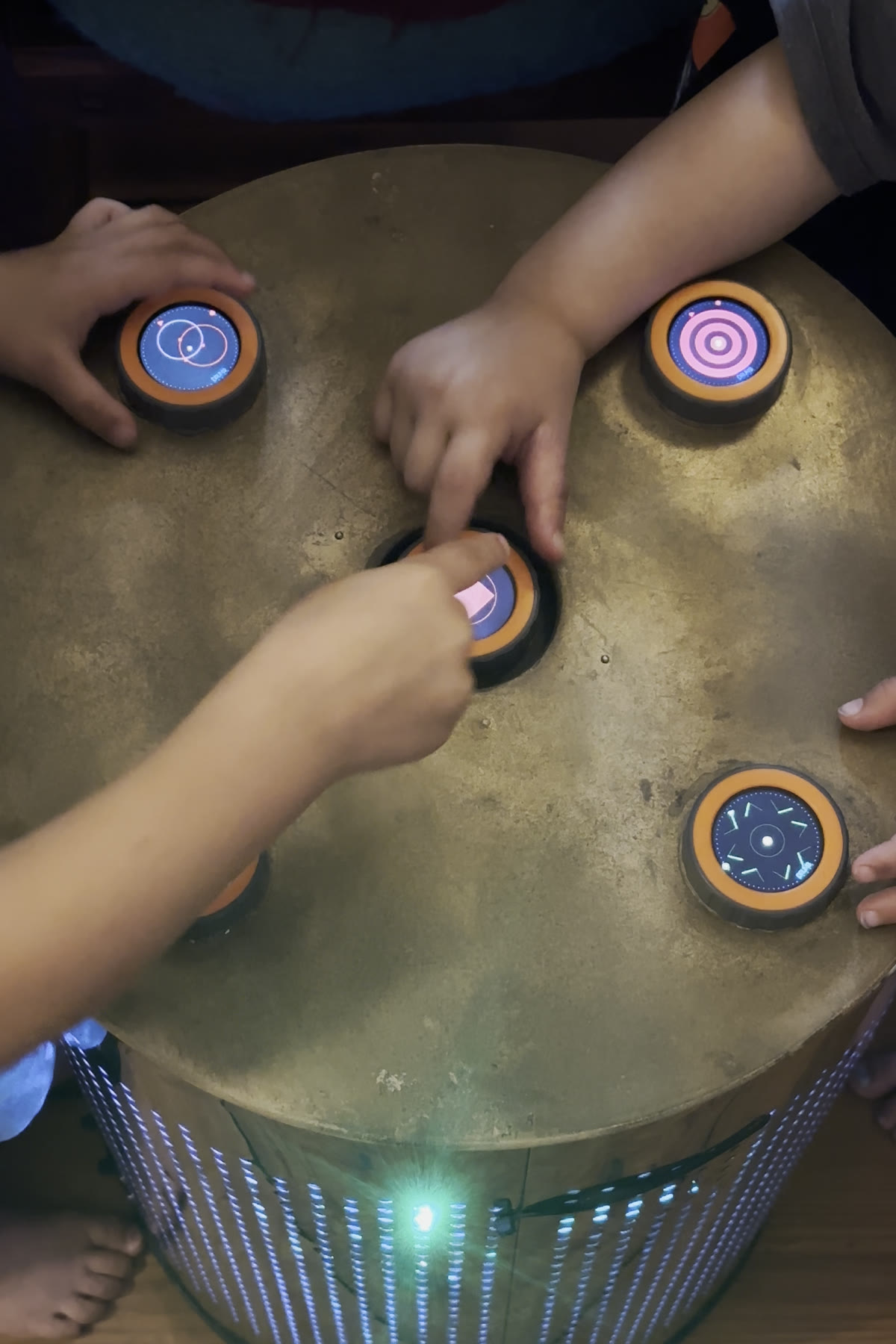
Two years of workshops, a hacked sampler and fifteen children who all wanted to press at once. What came out of it was not a better machine — it was a rule.
At the end of two years of workshop practice there was no better machine. There was a sentence:
A children's interface does not come from making everything reachable. It comes from deliberately limiting what can be reached.
That sentence is in the field report on Beatmachine 3.0 — the name of the stage the machine had reached after two years at the Manege youth club in Berlin-Neukölln. It was always the same machine; the numbers count the stages, not the devices. And that sentence is the reason TAMBUM looks the way it does today.
The idea behind every version
From the start this was never about a device that can make music. It was about one that only comes alive when children feed sounds into it from outside.
In practice that means: no ready-made presets, no hidden sound libraries. Sampling as the central principle — whatever goes in, the children bring with them.
The way through a hacked sampler
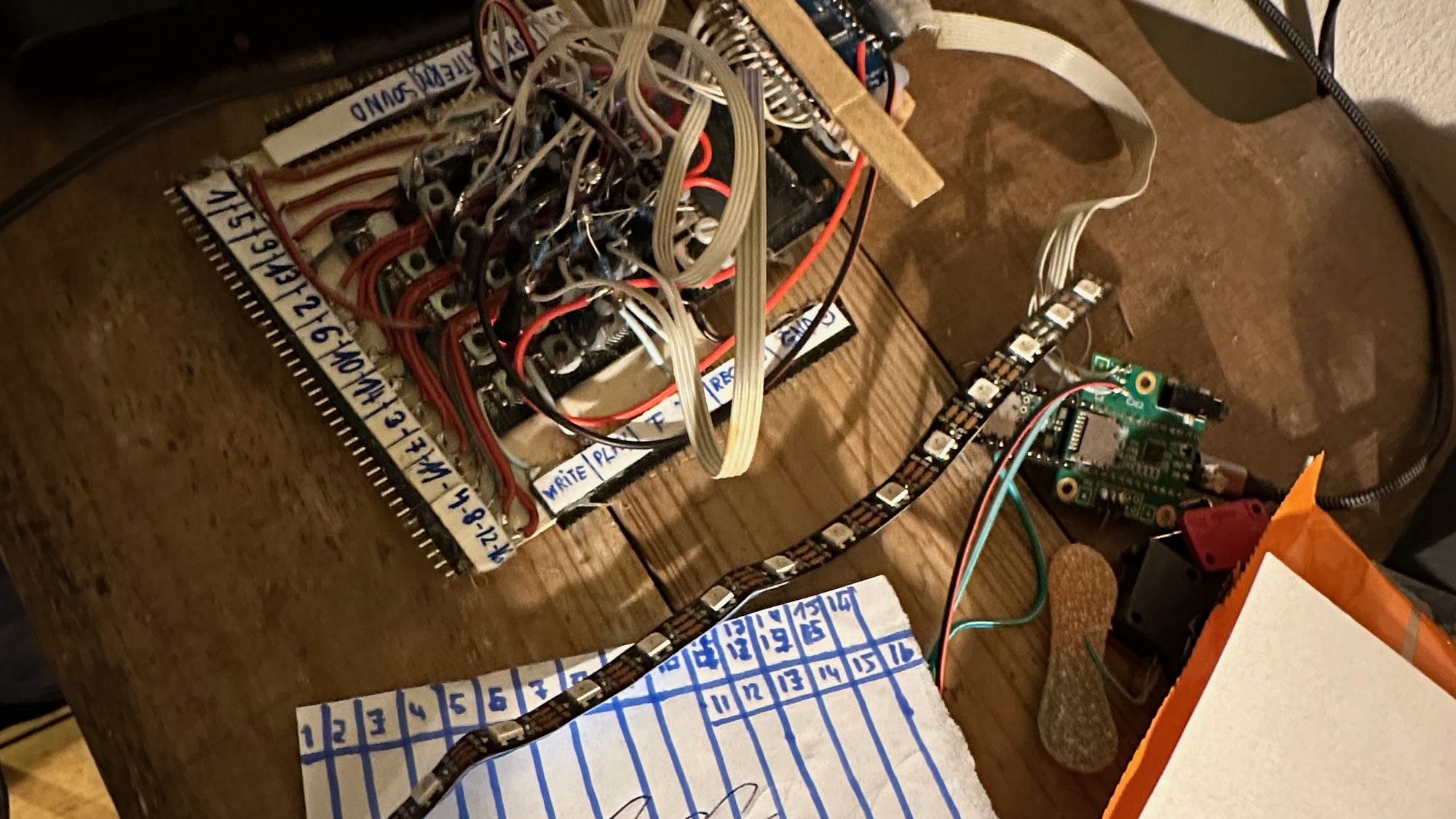
The sound engine was settled from the beginning: the Pocket Operator PO-33 by Teenage Engineering. Rather than eventually building a sampler from scratch, that decision stood — sampling, sequencer and effects were taken care of, and the work could go where the questions were: to the interface.
Analysing the original device produced three findings:
- The interface is designed for one person.
- The complexity does not sit on the surface but in the depth of the operation — in key combinations and menus.
- It is a tool for your pocket, not a collaborative instrument for learning.
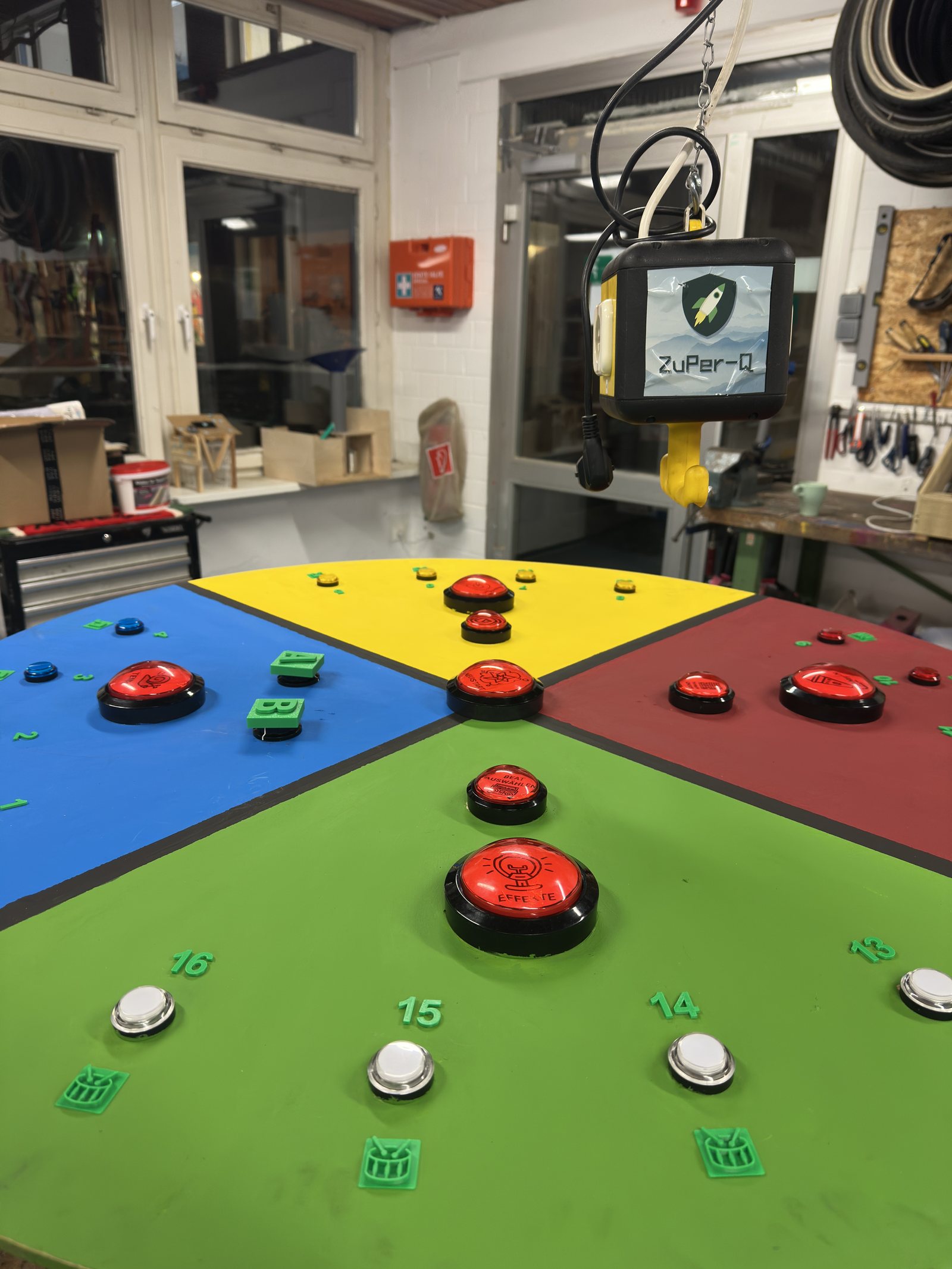
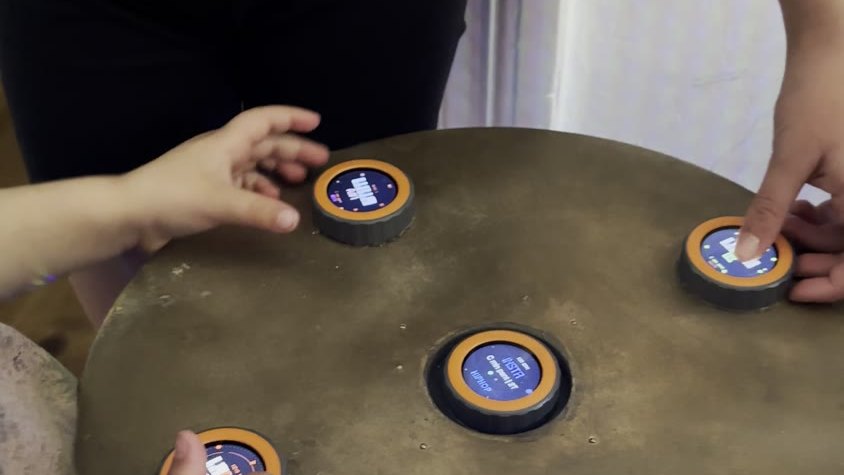
That is exactly where the workshop went to work. The PO-33 has no casing at all — it is a bare circuit board. The contact points of its keys were tapped directly and led outwards. The tiny original keys became large, clearly visible buttons — more than sixteen of them. And those buttons moved onto a round table.
That changed the character of the instrument completely. It became performative: children move around the table, press at the same time, react to one another. Functions hidden in key combinations on the original became visible and physically graspable.
And then came the flip side
A complex machine stays complex — even when you make it bigger.
The original expectation was: one facilitator and two or three children working together in a structured way. In practice eleven to fifteen children stood around the table at once.
- Everyone wanted to press at the same time.
- There was no clear mode; every function was available in principle.
- The gap between planned and actual use became very clear.
On the PO-33 every function was used — sampling, effects, live record. Only afterwards did it become clear that this is too much for children. The complexity of the original machine had not gone away. It had only become bigger and louder.
What worked instead
Two things went noticeably well in the same workshops — and both were radically reduced.
Sound objects with piezo sensors. Wooden discs with springs, tin cans, pieces of metal, simple resonating bodies, everyday material that sounds interesting when struck, rubbed or pulled. The children listened closely and experienced it directly: I can make sound with my hands, my body and material.
A mini sampler with two buttons. The ISD1820 module does exactly two things: record and play. One button for record, one for play. No menu, no key combination. I record my voice — and here it comes back out.
The report notes an observation that explains more than any feature list: a boy who at first had little trust was won over by building and using precisely this small sampler together. He was visibly proud to operate it.
The finding: constraint design
Children press every visible button out of curiosity. That is not misuse. That is the use.
Which means: making buttons bigger and more colourful is not enough. You have to create modes in which only a reduced set of functions is active at a time. The report describes the concept like this:
- A rotary switch determines the mode.
- In each mode only certain buttons are genuinely active — and only those light up.
- Everything else is physically separated and does nothing, even when pressed at random.
The lessons alongside it: fewer functions, but stable ones. A modular build instead of one big, overloaded hack. And more testing time before the workshops, so there is more room for the children on the day.
Two different processes
Before the line is drawn to TAMBUM, one sentence belongs in between, and it is easily missed: building a machine and building beats on it are two different processes.
The workshop series were building workshops. There was soldering, sawing and shaping — that takes tools, patience and care, and it is not meant for every age. Playing a finished instrument takes none of that.
Which is why TAMBUM is not a shrunken Beatmachine either. It is a new build: different electronics, different operation, different audiences. What came out of the workshop is not the hardware — it is the insight.
What became of it: TAMBUM
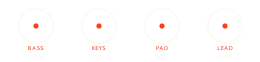
TAMBUM is that one sentence, built.
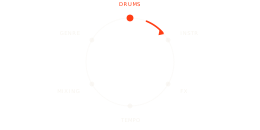
The middle puck is the rotary switch. It leads through six menus, and each one follows a different rule — drums, instruments, effects, tempo, mixing, genre. Whatever is not in play right now is not merely out of reach; it is simply not there.
Instead of fifteen children at one table with sixteen buttons, there are four places with one disc each. In its menu, each disc does exactly one thing — and does it completely.
There is no key combination and no hidden menu. The displays carry single words, not sentences — and nobody has to read them, because every mode also has a picture of its own. Keep turning and you come round again.
The report closes with a sentence that stands over TAMBUM as well: a good instrument for children is not the one that can do the most, but the one that makes it clearest what sound, sampling and playing together actually mean.
---
Beatmachine 3.0 was an open, free workshop series at the Manege youth club, Rütlistraße 1 in Berlin-Neukölln, funded by Bezirksjugendring Neukölln. Eleven to fifteen children aged eight to fourteen came to each session, and the workshops lasted two to three hours. The closing presentation took place on 9 December 2025.
Read on
-
 How TAMBUM came about
One question, two workshop series at the Manege youth club in Neukölln and more than 20 children: from a first cardboard machine with arcade buttons to a prototype that really sounded.
2026-08-02 · History · Daniel Vishnya WerkstattNeuköllnPrototypTeenage EngineeringManege